
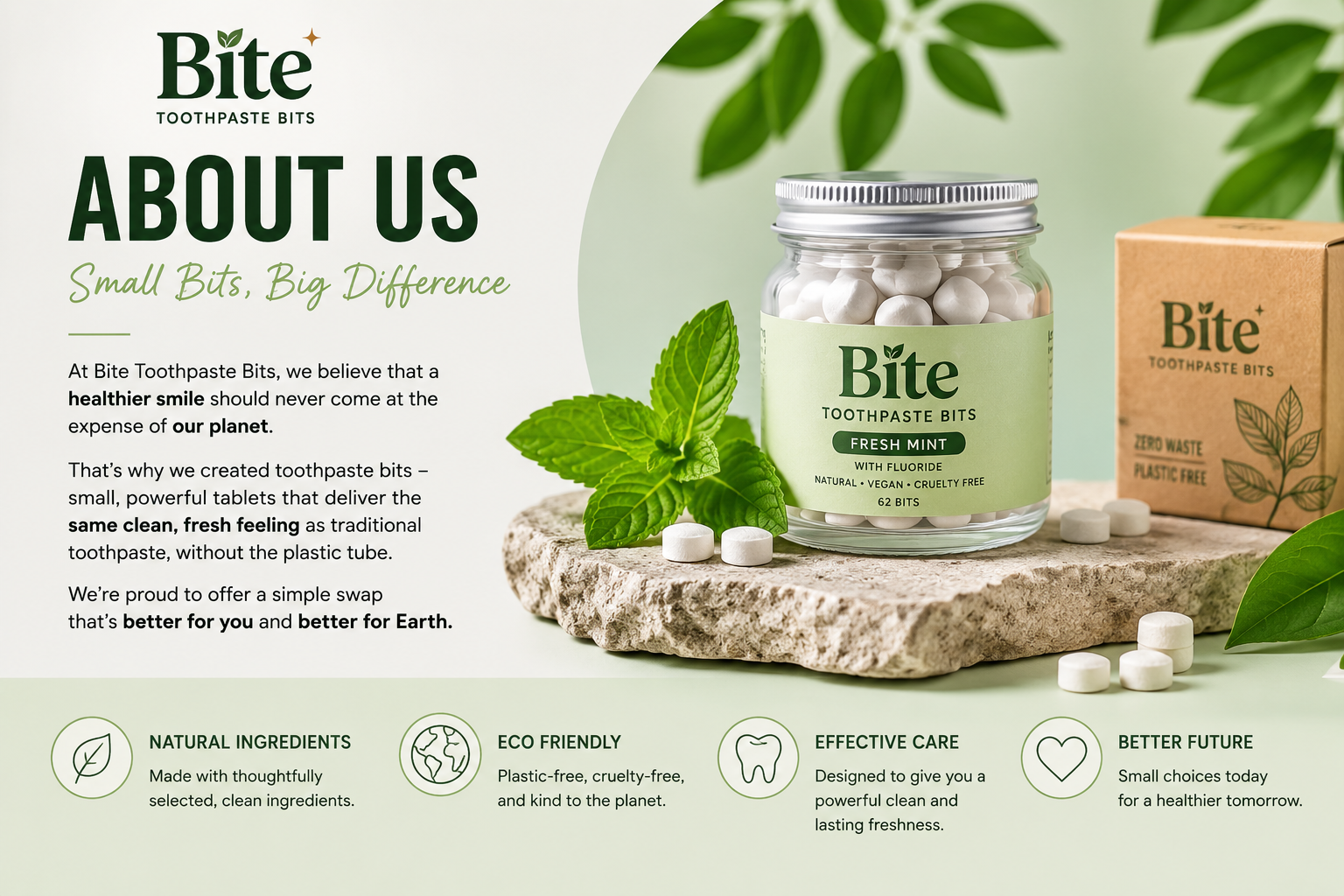
The bitetoothpastebits.com about us story begins with a simple question: why should something as routine as brushing your teeth create unnecessary plastic waste?
Bite was founded by Lindsay McCormick after she began questioning the environmental impact of conventional toothpaste packaging. What started with homemade toothpaste tablets pressed on a living-room floor eventually developed into Bite, a personal-care company built around refillable packaging, carefully selected ingredients, and products designed to reduce reliance on single-use plastic.
Today, the company is best known for its Toothpaste Bits—small tablets that are chewed before brushing—but its story goes beyond replacing toothpaste tubes. Bite has expanded into a broader personal-care brand while maintaining sustainability as a central part of its identity.
Bite Toothpaste Bits at a Glance
| Quick Fact | Details |
|---|---|
| Brand | Bite |
| Founder | Lindsay McCormick |
| Founded | 2017 |
| Signature Product | Toothpaste Bits |
| Original Concept | Toothpaste without conventional plastic tubes |
| Headquarters/Production | Toothpaste Bits, Mouthwash Bits and Whitening Gel are made in California |
| B Corp Status | Certified B Corporation |
| Product Options | Fluoride and fluoride-free Toothpaste Bits |
| Packaging Approach | Refillable glass containers and compostable refill pouches |
| Brand Focus | Oral care, personal care and reducing plastic waste |
Bite states that its Toothpaste Bits, Mouthwash Bits and Whitening Gel are produced in California. The company also identifies itself as vegan and cruelty-free certified and says its toothpaste and mouthwash tablets hold Palm Oil Free certification from the Orangutan Alliance.
How the Bite Story Started
A Problem Found Outside the Bathroom
Before Bite became a recognizable oral-care brand, founder Lindsay McCormick worked as a surf instructor and spent significant time around the ocean.
According to Bite’s official story, learning about the enormous number of toothpaste tubes entering landfills and oceans each year made her rethink something most people rarely question: the packaging surrounding their daily toothpaste.
She searched for an alternative but was dissatisfied with the available combination of ingredients and plastic packaging.
Instead of accepting the existing options, she began experimenting.
From Online Chemistry Courses to Homemade Tablets
McCormick took online chemistry courses and learned how to create compressed toothpaste tablets. The earliest versions were made for friends and family directly from her living room.
That detail matters because Bite did not begin as a large beauty corporation trying to add an environmentally positioned product to an existing portfolio. The product concept came first, built around solving a specific everyday packaging problem.
Bite marks August 2017 as the beginning of that journey.
How Bite Toothpaste Bits Work
The concept changes the format of toothpaste rather than eliminating brushing itself.
Instead of squeezing paste from a tube, users:
- Place one Toothpaste Bit in their mouth.
- Gently chew it until it breaks into a soft powder.
- Brush with a wet toothbrush for approximately two minutes.
- Spit after brushing and repeat the routine twice daily.
Bite says the tablet foams when used with a wet toothbrush, creating an experience intended to feel familiar despite the different format.
The pre-portioned tablet also removes the need to estimate how much toothpaste to squeeze onto a brush.
Why Bite Chose Tablets Instead of Traditional Toothpaste
The tablet format supports several elements of Bite’s overall product philosophy.
Less Dependence on Disposable Toothpaste Tubes
Conventional toothpaste is usually packaged in squeezable tubes that can be difficult to reuse.
Bite instead uses glass bottles and jars with aluminum lids. Subscription refills are sent in home-compostable pouches designed to be transferred into the reusable jar.
The idea is straightforward: keep the durable container and replace only the product inside it.
Pre-Portioned Brushing
Every Bit contains a predetermined amount of product, reducing the need to squeeze out an arbitrary quantity.
For consumers who tend to use more toothpaste than necessary, the format may also make each serving more consistent.
Travel Convenience
Because Toothpaste Bits are dry tablets rather than tubes of paste, they can be easier to pack without worrying about leaking toothpaste.
Bite describes its tablets as travel-friendly and suitable for taking through TSA screening.
Less Sink Mess
Bite also promotes tablets as a cleaner alternative around the sink because the dry format does not behave like sticky conventional paste.
For some shoppers, these practical benefits may be nearly as important as the environmental motivation.
What Is Inside Bite Toothpaste Bits?
Ingredient transparency is an important part of evaluating any oral-care product.
Bite currently lists separate formulas for its fluoride and fluoride-free options.
Fluoride-Free Toothpaste Bits
The Mint fluoride-free formula includes ingredients such as:
- Erythritol
- Xylitol
- Calcium carbonate
- Peppermint flavor
- Nano-hydroxyapatite
- Sodium bicarbonate
- Guar gum
- Sodium cocoyl glutamate
- Zinc citrate
- Silicon dioxide
- Menthol
The Mint Charcoal formula adds activated charcoal, while the Berry formula uses natural berry flavor and has a somewhat different ingredient profile.
Toothpaste Bits With Fluoride
Bite also offers a fluoride formula.
Its listed active fluoride ingredient is sodium monofluorophosphate 0.76%, providing 0.14% w/w fluoride ion, alongside ingredients including calcium carbonate, silica, xylitol, sodium bicarbonate and zinc citrate.
This distinction is important because older discussions about Bite sometimes describe the brand simply as fluoride-free. That is no longer an accurate description of its complete product range.
Consumers can now choose between fluoride and fluoride-free versions.
Nano-Hydroxyapatite and Bite’s Fluoride-Free Formula
Bite’s fluoride-free Toothpaste Bits contain nano-hydroxyapatite, commonly shortened to nHAp.
The company positions nHAp as an alternative ingredient in its fluoride-free formulation and says it is used to support enamel and sensitivity-related oral-care goals. Bite itself recommends speaking with a dentist when considering nano-hydroxyapatite or making meaningful changes to an oral-care routine.
That advice is worth following.
A sustainable format should not be the only factor used when choosing toothpaste. Individual cavity risk, dental history, age and professional recommendations can all influence which formulation is appropriate.
Bite’s Mission: Personal Care With Less Plastic
The central theme behind the bitetoothpastebits.com about us page is not simply selling toothpaste in a different shape.
Bite states that it was founded around the belief that maintaining a bright smile should not require compromising either personal well-being or the environment. Its broader message is that small changes to everyday routines can create a larger collective effect.
This explains why Bite eventually expanded beyond toothpaste.
The company views the bathroom as a category filled with frequently replaced products and disposable packaging—and therefore as an opportunity for redesign.
From Toothpaste Brand to Personal-Care Company
Bite’s official timeline shows how quickly the company expanded.
2017: The First Tablets
The first toothpaste tablets were pressed in Lindsay McCormick’s living room in August 2017.
2018: Bite Goes Viral
By August 2018, Bite says the brand had gained viral attention online.
2020: Appearing on Shark Tank
In March 2020, Bite appeared on Shark Tank and received two offers, according to the company’s timeline.
Later that year, Bite expanded its oral-care range.
2021: Moving Beyond Oral Care
In September 2021, Bite launched deodorant, marking a significant transition from a toothpaste-focused business into a wider personal-care brand.
2022: B Corp Certification
Bite became a certified B Corporation in September 2022.
Its impact report says the company also operates as a Public Benefit Corporation and incorporated its stated social and environmental principles into its corporate governance.
What Does Bite’s B Corp Certification Mean for Shoppers?
Bite’s B Corp certification is particularly relevant to consumers researching the company rather than simply comparing toothpaste flavors.
B Corp certification evaluates businesses across areas that extend beyond their products, including governance, workers, community, customers and environmental impact.
Bite organizes its own impact reporting around five similar categories:
- Governance
- Environment
- Customers
- Workers
- Community
The company says its sustainability efforts include waste diversion, sustainable materials, carbon-neutral initiatives and environmental education.
Certification should not replace independent evaluation of individual products, but it gives shoppers an additional framework for understanding how environmental and social commitments fit into Bite’s business structure.
Bite’s Approach to Packaging
Packaging is one of the clearest differences between Bite and conventional toothpaste brands.
Refillable Glass Containers
Bite says it uses glass bottles and jars with aluminum lids rather than disposable plastic toothpaste tubes.
The jars are intended to be reused as refills arrive. If a customer stops using them, the company recommends recycling or repurposing the containers.
Compostable Refill Pouches
Subscribers receive replacement Bits in home-compostable refill pouches rather than receiving a new glass jar with every shipment.
Bite says these pouches are intended to be emptied into the original glass container.
This refill model is important because repeatedly shipping heavy reusable containers could undermine some of the advantages of reusable packaging.
Paper-Based Shipping Materials
According to its FAQ, Bite uses kraft envelopes padded with post-consumer recycled newspaper, recyclable corrugated cardboard boxes and paper tape for relevant shipments.
Bite’s Reported Environmental Impact
Bite also publishes specific environmental-impact figures.
Its 2022 impact report stated that the company diverted 75,000 pounds of plastic waste during 2022 through its product and packaging model.
The company’s current About page states that its community has collectively kept 250,000 pounds of plastic out of landfills and oceans.
These numbers are company-reported impact figures, so they are best understood in that context rather than treated as independently audited environmental comparisons with every alternative toothpaste format.
Is Bite Vegan and Cruelty-Free?
According to Bite, yes.
The company states that it is certified Vegan and Cruelty Free through PETA’s Beauty Without Bunnies program. Bite also says its Toothpaste Bits and Mouthwash Bits are certified Palm Oil Free by the Orangutan Alliance.
Bite further states that its products are not tested on animals.
For consumers who prioritize these criteria, these certifications provide more useful information than vague marketing labels such as “eco-conscious” or “clean.”
Where Are Bite Products Made?
Bite says its:
- Toothpaste Bits
- Mouthwash Bits
- Whitening Gel
are made in California.
Not every component in the company’s broader product catalog is American-made.
For example, Bite explains that its bamboo toothbrush uses moso bamboo sourced from China. The company says the toothbrush and floss are transported in bulk by sea rather than air as part of its efforts to reduce transportation-related environmental impact.
This level of sourcing detail is useful for shoppers who want to distinguish between “made in the USA” claims for particular products and the sourcing footprint of an entire product range.
Bite Toothpaste Bits vs. Traditional Toothpaste
| Feature | Bite Toothpaste Bits | Typical Tube Toothpaste |
| Format | Dry tablet | Paste or gel |
| Portioning | Pre-portioned | User-controlled |
| Primary Container | Refillable glass jar | Disposable tube |
| Refills | Compostable pouches available | Usually another tube |
| Travel | Compact dry format | Liquid/paste restrictions may apply |
| Fluoride Choice | Fluoride and fluoride-free options | Depends on product |
| Application | Chew, then brush | Apply directly to brush |
| Subscription | Available | Depends on retailer/brand |
The strongest reason to choose Bite is therefore not simply that “tablets are better.”
The better question is whether Bite’s combination of formulation, refill system, convenience and environmental priorities matches what an individual consumer wants from their oral-care routine.
Who May Like Bite Toothpaste Bits?
Bite may appeal particularly to people who:
- Want to reduce disposable plastic in their bathroom.
- Prefer reusable containers.
- Travel frequently.
- Like precisely portioned products.
- Want a choice between fluoride and fluoride-free toothpaste tablets.
- Prefer vegan and cruelty-free personal-care brands.
- Are comfortable switching from paste to a chewable tablet.
- Value businesses that publish environmental-impact information.
What to Consider Before Switching
No toothpaste is automatically the right choice for everyone.
Choose Your Formula Carefully
Bite sells both fluoride-containing and fluoride-free Toothpaste Bits, so buyers should check which version they are purchasing.
People with specific dental needs should discuss toothpaste choices with a dentist rather than selecting solely on environmental claims.
Tablets Require a Small Habit Change
Using a Bit requires chewing the tablet before brushing.
Some users may enjoy the convenience immediately, while people strongly accustomed to traditional paste may need time to adjust.
Keep the Bits Dry
Bite recommends keeping tablets in an airtight container.
Exposure to moisture or humidity can soften or discolor the tablets, making proper storage especially important in humid bathrooms.
Keep Them Away From Pets
This is an important detail that can easily be missed.
Bite warns that its Bits contain xylitol and must be kept away from dogs and cats because xylitol is toxic to pets.
Common Mistakes When Researching Bite
Assuming Bite Is Still Fluoride-Free Only
Older reviews may describe Bite as exclusively fluoride-free.
The company now sells a fluoride version alongside formulas containing nano-hydroxyapatite.
Always check current product labeling rather than relying on an older article.
Looking Only at the Packaging
Plastic reduction is central to Bite’s identity, but toothpaste still needs to fit your oral-health needs.
Review the ingredients and formulation before buying.
Confusing “Sustainable” With “Zero Impact”
Reusable and compostable packaging can reduce certain forms of waste, but no manufactured consumer product has literally zero environmental footprint.
A more useful evaluation considers packaging, production, shipping, ingredient sourcing, product lifespan and whether consumers actually reuse the container.
Ignoring Refill Behavior
A reusable jar creates the most practical value when it is genuinely reused.
Buying new containers repeatedly rather than using the refill system would weaken one of the core advantages of the model.
Frequently Asked Questions
Who founded Bite Toothpaste Bits?
Bite was founded by Lindsay McCormick, who remains identified by the company as its CEO and founder. The first tablets were created after she began exploring alternatives to conventional toothpaste packaging.
When was Bite founded?
Bite traces its beginnings to August 2017, when McCormick began pressing toothpaste tablets from her living room.
Was Bite Toothpaste Bits on Shark Tank?
Yes. Bite appeared on Shark Tank in March 2020 and, according to the company’s official history, received two offers.
Is Bite Toothpaste fluoride-free?
Bite offers both fluoride and fluoride-free Toothpaste Bits.
Its fluoride formula contains sodium monofluorophosphate, while its fluoride-free formulas contain nano-hydroxyapatite.
Is Bite Toothpaste Bits vegan?
Bite states that its Bits are vegan and cruelty-free and that the brand holds PETA Beauty Without Bunnies certification.
Is Bite a B Corp?
Yes. Bite’s official timeline states that the company became a certified B Corporation in September 2022.
Are Bite Toothpaste Bits made in the USA?
Bite says its Toothpaste Bits, Mouthwash Bits and Whitening Gel are made in California. Some products and materials elsewhere in its catalog are sourced internationally.
How do you use Bite Toothpaste Bits?
Place one tablet in your mouth, gently chew it into a soft powder, then brush with a wet toothbrush for two minutes before spitting.
Does Bite use plastic toothpaste tubes?
Bite’s Toothpaste Bits are packaged around a refill system rather than conventional toothpaste tubes. The company uses glass jars and sends subscription refills in home-compostable pouches.
Are Bite Toothpaste Bits safe around dogs?
They should be kept away from pets. Bite specifically warns that the tablets contain xylitol, which is toxic to dogs and cats.
The Bigger Idea Behind Bite
The most interesting part of Bite is not that toothpaste can be made into a tablet.
It is the company’s attempt to rethink an everyday product that most consumers had little reason to question.
Toothpaste had been sold in roughly the same disposable format for decades. Bite approached the problem from another direction: keep the brushing routine familiar while changing the form, portioning and packaging of the toothpaste itself.
That thinking has since expanded into mouthwash, whitening and personal-care products.
Whether every Bite product is right for every consumer is a separate question. But from a brand-strategy perspective, the company demonstrates how a sustainability-focused business can start by identifying waste inside an ordinary routine and redesigning the product around it.
Final Thoughts on bitetoothpastebits.com about us
The bitetoothpastebits.com about us story is ultimately about turning a familiar daily habit into an opportunity for product innovation.
Lindsay McCormick began experimenting with toothpaste tablets in 2017 after becoming concerned about disposable toothpaste packaging. From those living-room experiments, Bite grew into a B Corp-certified personal-care company offering refillable Toothpaste Bits, fluoride and fluoride-free formulas, mouthwash products and other alternatives to traditionally packaged bathroom essentials.
For consumers researching Bite, the most useful takeaway is to look beyond the novelty of toothpaste tablets. Consider the formulation that meets your dental needs, how consistently you will reuse the packaging, the company’s certifications and sourcing disclosures, and whether the tablet format genuinely makes your daily routine easier.
That combination of practical oral care, reusable packaging and a mission built around reducing everyday plastic waste is what defines the Bite story today.
