
Search Intent Analysis
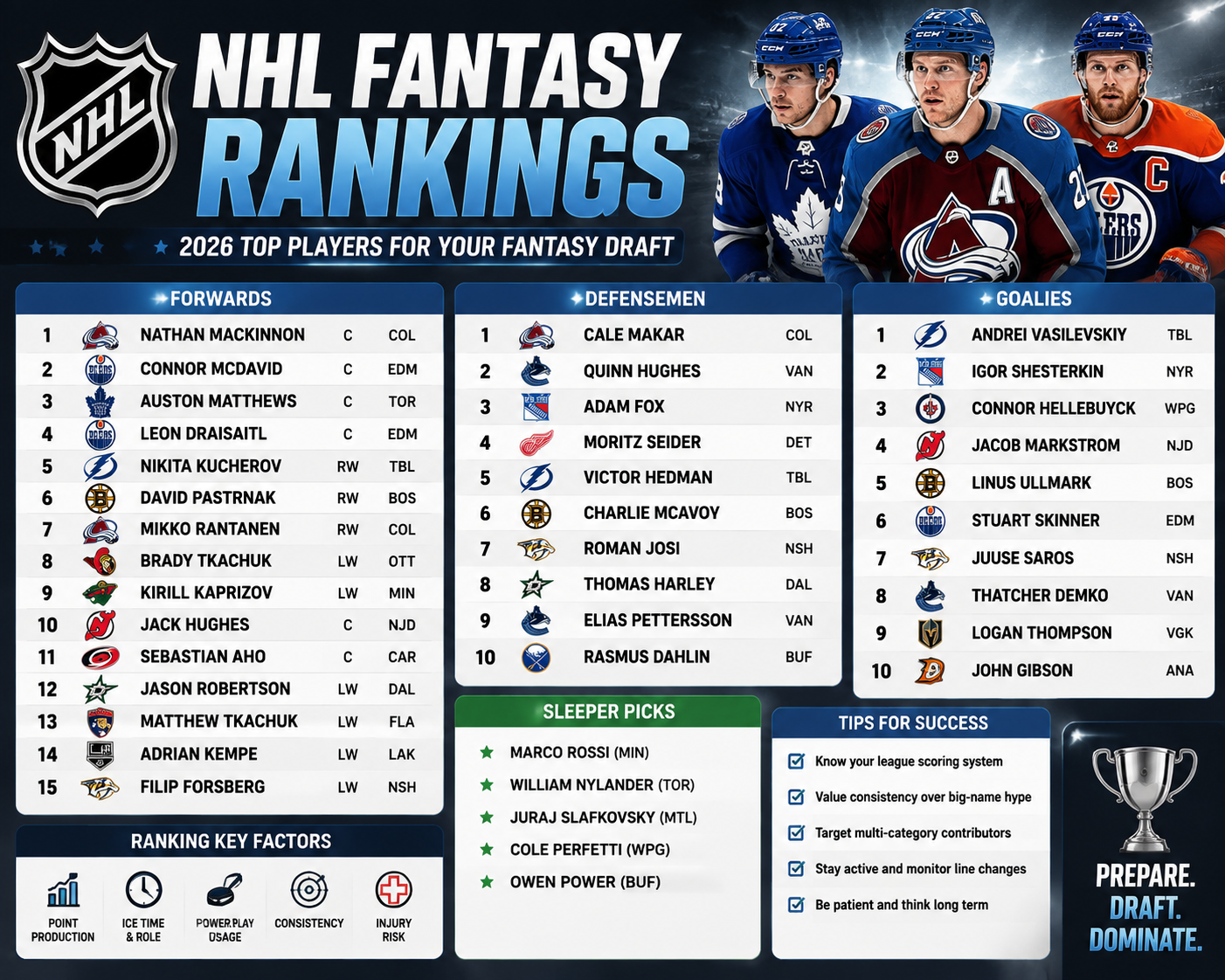
The keyword nhl fantasy rankings has a primarily informational and guide-focused search intent. Users searching this term are usually fantasy hockey managers preparing for drafts, making lineup decisions, comparing players, or looking for updated evaluations before the NHL season begins.
The ideal content should go beyond a simple list of players. A strong resource needs to explain ranking methods, draft strategy, position value, breakout candidates, risk factors, and how managers can use rankings throughout the season.
NHL Fantasy Rankings: The Complete Guide to Drafting a Championship Fantasy Team
Building a winning fantasy hockey roster starts with reliable nhl fantasy rankings. Whether you are entering a competitive league with friends, managing a dynasty team, or preparing for a season-long fantasy battle, understanding player value is the difference between a playoff contender and a bottom-ranked team.
Fantasy hockey is not only about choosing the biggest names. A player’s real fantasy value depends on scoring format, ice time, power-play opportunities, team role, injury history, and long-term consistency.
The best managers use rankings as a foundation, then adjust based on league settings and personal strategy.
Quick Facts About NHL Fantasy Rankings
| Factor | Why It Matters |
|---|---|
| Position scarcity | Elite centers and defensemen can provide major advantages |
| Power-play role | Special teams usage often creates fantasy production |
| Line combinations | Top-line players receive more scoring opportunities |
| Advanced statistics | Helps identify undervalued players |
| Injury risk | Affects season-long reliability |
| Team strength | Better offenses create more fantasy chances |
How NHL Fantasy Rankings Are Created
Professional fantasy rankings are not random predictions. They combine multiple performance indicators to estimate future value.
Statistical Production
The first factor is traditional production:
- Goals
- Assists
- Points
- Shots on goal
- Power-play points
- Hits
- Blocks
- Penalty minutes
- Plus/minus, depending on league format
A player scoring 90 points may appear valuable, but fantasy managers need to understand how those points are distributed.
For example, a winger who scores heavily on the power play may have more value in certain formats than a balanced player with similar total points.
Role and Ice Time
Opportunity drives fantasy production.
A talented player playing 14 minutes per night may have less fantasy upside than a slightly less talented player receiving 21 minutes with first-line responsibilities.
Important role indicators include:
- Top-six forward placement
- First power-play unit usage
- Top defensive pairing assignment
- Faceoff responsibility
- Late-game deployment
Advanced Analytics
Modern fantasy managers use deeper metrics to identify hidden value.
Important statistics include:
- Expected goals (xG)
- Corsi percentage
- Shot share
- Individual scoring chances
- Expected assists
- Zone-start percentage
These numbers can reveal whether a player’s performance is sustainable or inflated by luck.
Understanding Fantasy Hockey Player Tiers
Instead of viewing rankings as one long list, managers should think in tiers.
Elite Fantasy Players
These are players capable of carrying fantasy teams.
Typical characteristics:
- Consistent point production
- Heavy minutes
- Strong power-play involvement
- Low risk of losing their role
Elite players usually disappear quickly in drafts because managers understand their value.
Second-Tier Stars
These players may not dominate every category but provide excellent overall production.
They often include:
- Young players entering their prime
- Consistent veterans
- High-volume shooters
- Reliable point producers
These selections often determine whether a fantasy team becomes competitive.
Breakout Candidates
Breakout players are among the most exciting parts of fantasy hockey.
A breakout candidate often shows:
- Increased ice time
- Better linemates
- Improved underlying statistics
- Strong performance late in the previous season
- New coaching opportunities
Finding these players before they become household names creates a major fantasy advantage.
How to Use NHL Fantasy Rankings During Drafts
Rankings are most useful when combined with draft strategy.
Do Not Draft Only by Name Value
A common fantasy mistake is selecting famous players because of reputation.
A player’s previous achievements do not guarantee future fantasy success.
Always ask:
- Is their role changing?
- Are they getting older?
- Has their team improved?
- Are their numbers declining?
- Are younger players taking opportunities?
Balance Risk and Reliability
Championship teams usually contain a mix of:
- Safe veteran producers
- High-upside young players
- Late-round sleepers
Selecting only risky players creates unnecessary uncertainty.
Pay Attention to Position Scarcity
Some positions are harder to fill than others.
For example:
- Elite defensemen can be difficult to replace.
- Top-tier goalies often provide significant advantages.
- Quality centers may have more value in leagues requiring multiple center slots.
Draft value depends heavily on your league settings.
Fantasy Hockey Ranking Mistakes to Avoid
Many managers lose value because they misunderstand how rankings should be used.
Ignoring League Settings
A rankings list cannot perfectly fit every league.
Different formats reward different skills.
Examples:
A points-only league values scoring heavily.
A category league may reward:
- Hits
- Blocks
- Shots
- Faceoffs
- Penalty minutes
Always adjust rankings based on your scoring system.
Overvaluing Last Season’s Performance
A career-best season does not always repeat.
Managers should investigate:
- Shooting percentage changes
- Team changes
- Role changes
- Injury history
A player who scored 40 goals because of an unusually high shooting percentage may carry more risk the following year.
Waiting Too Long on Goaltenders
Goalies are unpredictable, but elite options can create a huge advantage.
Fantasy managers should evaluate:
- Starting role security
- Team defense
- Save percentage trends
- Workload expectations
A strong goalie strategy can separate playoff teams from average teams.
Key Factors That Influence Fantasy Player Value
Team Environment
A player’s team situation directly impacts fantasy production.
Strong offensive teams usually create:
- More scoring chances
- More power-play opportunities
- Higher assist totals
However, players on weaker teams may also provide value because they receive heavy minutes.
Line Chemistry
Hockey relies heavily on player combinations.
A talented player paired with strong linemates can experience a major fantasy boost.
Monitor:
- Training camp updates
- Coaching decisions
- Line combinations
Age and Development
Age affects player projections.
Young players may improve rapidly, while older players may experience declining production.
Fantasy managers should understand where each player is in their career cycle.
NHL Fantasy Rankings Strategy for Different League Types
Standard Points Leagues
Focus on:
- Goals
- Assists
- Total points
- Power-play production
High-scoring forwards become extremely valuable.
Category Leagues
Managers should target players who contribute across multiple areas.
A player producing:
- Goals
- Hits
- Shots
- Blocks
- Assists
can outperform a one-dimensional scorer.
Dynasty Fantasy Leagues
Long-term potential becomes more important.
Managers should prioritize:
- Young stars
- Prospect development
- Future opportunity
- Organizational stability
A 21-year-old player with rising production may have more dynasty value than an aging veteran.
Fantasy Hockey Sleeper Picks: Finding Hidden Value
Every successful fantasy season includes surprise performers.
Sleeper candidates often come from:
Young Players Receiving Bigger Roles
A player moving from a bottom-six role into a top-line position can see dramatic improvement.
Players Returning From Injury
Injured players may be undervalued because managers focus on recent statistics.
Players Changing Teams
A trade or free-agent move can completely change fantasy value.
A player joining a stronger offensive system may see increased production.
How Often Should You Update NHL Fantasy Rankings?
Fantasy rankings should not be viewed as permanent.
Player value changes throughout the season.
Important update points include:
- Training camp results
- Opening-week performance
- Injuries
- Trade deadlines
- Coaching changes
- Line adjustments
Active managers regularly adjust their rankings instead of relying on preseason expectations.
Expert Tips for Winning Fantasy Hockey Leagues
Watch Opportunity More Than Reputation
A player’s role often matters more than their previous statistics.
A second-line player promoted to the first power-play unit may become more valuable overnight.
Target Consistency Early, Upside Late
Early draft picks should provide stability.
Later picks should focus on potential breakout value.
Use Rankings as a Guide, Not a Rule
The best fantasy managers do not blindly follow rankings.
They understand why a player is ranked highly and decide whether that reasoning fits their league.
Final Thoughts on NHL Fantasy Rankings
The best nhl fantasy rankings are not simply lists of the biggest names in hockey. They are tools that help fantasy managers evaluate opportunity, consistency, upside, and risk.
Successful fantasy hockey teams are built through preparation. Understanding player roles, monitoring changes, and adjusting rankings throughout the season can provide a major competitive advantage.
Use rankings as your starting point, combine them with smart strategy, and build a roster designed to win when the fantasy playoffs arrive.
