
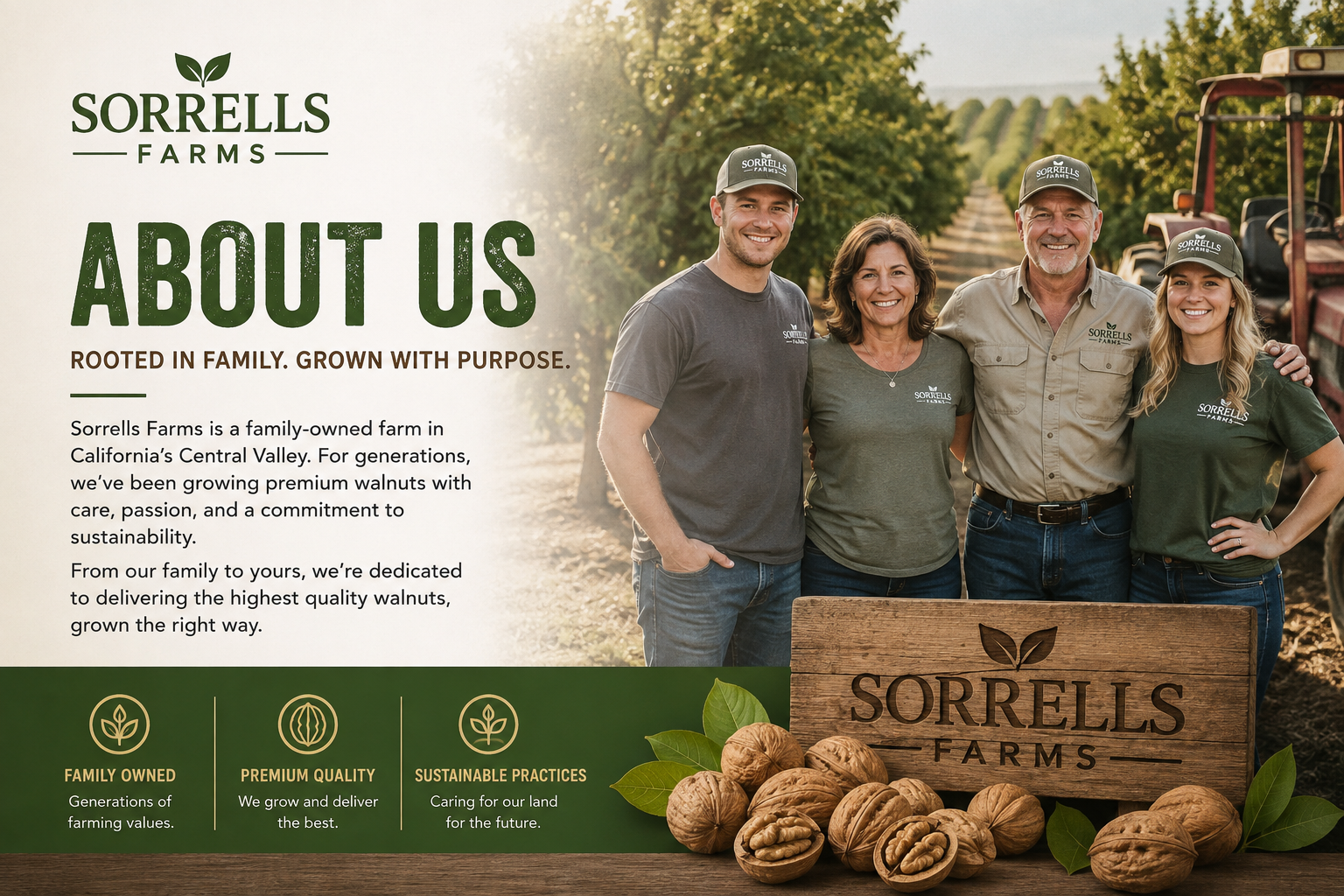
The Better Walnuts About Us story begins with something simple: a family orchard, generations of farming experience, and the belief that walnuts taste best when customers know where their food comes from.
Based in Red Bluff, California, Better Walnuts connects customers more directly with orchard-grown walnuts instead of relying solely on a long, anonymous supply chain. The family has been connected to walnut farming for nearly 50 years, turning decades of orchard knowledge into a farm-direct business built around freshness, traceability, and personal service.
For customers searching for the people behind Better Walnuts—or comparing the business with information found on SorrellsFarms.com About Us—this guide explains the farm’s history, growing approach, products, and what makes the two family-farm stories different.
Better Walnuts at a Glance
| Quick Fact | Better Walnuts |
|---|---|
| Location | Red Bluff, California |
| Farm Type | Multigenerational family walnut operation |
| Main Specialty | Chandler English walnuts |
| Family Orchard | Approximately 17 acres |
| Additional Orchard | Approximately 10 leased acres |
| Organic Offering | Certified organic walnuts from the leased orchard |
| Sales Model | Farm-direct and selected local retail |
| Shipping | Continental United States |
| Farming Heritage | Family walnut orchard for nearly 50 years |
Better Walnuts says its family orchard is approximately 17 acres, while an additional 10-acre orchard across the street is leased and organically managed to produce its certified organic walnuts.
Where the Better Walnuts Story Began
Better Walnuts did not begin as a business created around a trendy food product. Walnuts were already part of the family’s everyday life.
The farm’s story describes childhood memories of gathering walnuts from the orchard and spending evenings cracking them by the fire with a grandfather. Those experiences established a personal connection with walnut farming long before selling directly to customers became part of the plan.
The family’s walnut orchard has existed for nearly five decades. Uncle John has farmed walnuts commercially for more than 40 years and now owns and manages the family’s 17-acre multigenerational orchard following the grandfather’s passing.
That history matters because Better Walnuts is not simply sourcing nuts and putting them into branded packaging. Its identity is rooted in an orchard the family has worked with across generations.
A Family Walnut Orchard in Red Bluff, California
Red Bluff, in Northern California, is home to the family’s walnut operation.
Walnut growing is seasonal work. An orchard requires attention long before nuts are ready to sell, and the final product customers receive represents months of agricultural work and decisions made at farm level.
For Better Walnuts, the connection between orchard and customer is central to the business. Rather than separating the farmer from the buyer, the company emphasizes knowing where the walnuts were grown and purchasing closer to the source.
The 17-Acre Family Orchard
At the center of the operation is a 17-acre multigenerational walnut orchard managed by the family.
This is an important part of the Better Walnuts identity. Customers are not simply buying a generic commodity under a brand name; they are buying from a business whose story is connected directly to a specific family orchard.
The Organically Managed Orchard
Better Walnuts also states that it leases and organically manages a separate 10-acre walnut orchard located across the street from the family property.
According to the farm, this orchard supplies its certified organic walnuts.
Keeping this distinction clear is useful for shoppers because not every product or orchard should automatically be assumed to have identical growing or certification status.
What Does Better Walnuts Grow?
Better Walnuts focuses heavily on Chandler walnuts, including farm-direct in-shell English walnuts and Chandler light halves and pieces.
Chandler is one of the recognizable English walnut varieties grown commercially in California. For buyers, however, the farm’s value proposition goes beyond variety alone.
The focus is on providing walnuts closer to their source and shortening the journey between orchard and customer.
In-Shell English Walnuts
In-shell walnuts appeal to customers who enjoy cracking their own nuts or prefer keeping walnuts protected by their natural shell until they are ready to eat.
They can also create a more traditional experience—one closely connected to the way the Better Walnuts family remembers enjoying walnuts together.
Chandler Light Halves and Pieces
For customers who prioritize convenience, Better Walnuts also offers shelled Chandler walnut halves and pieces when available.
These are easier to use for:
- Baking and desserts
- Breakfast dishes
- Salads
- Homemade granola
- Cooking
- Snacking
- Gift baskets
- Specialty recipes
Because walnuts are an agricultural crop, availability can change throughout the season rather than remaining identical year-round. Better Walnuts itself posts harvest and availability updates for customers.
Farm-Direct Walnuts and a Shorter Supply Chain
One of the strongest themes in the Better Walnuts About Us story is shortening the supply chain.
The family had enjoyed orchard-fresh walnuts for years before deciding to make them more directly available to other families.
That model creates a different buying experience from purchasing an unidentified walnut product through several layers of distribution.
Why Farm Traceability Matters
When customers buy directly from a farm, they can more easily understand:
- Where the food was grown
- Who produced it
- What variety they are purchasing
- Whether a product is certified organic
- When seasonal crops may become available
- Who to contact with questions
This transparency is particularly useful for agricultural products because harvest timing, appearance, size, and availability naturally vary.
Better Walnuts makes the farmer and orchard visible rather than treating the origin of the product as an afterthought.
A Multigenerational Approach to Farming
One of the most compelling parts of Better Walnuts is not acreage or packaging—it is continuity.
A grandfather, an uncle with more than four decades of commercial walnut-farming experience, and the next generation are all part of the farm’s story.
That gives the brand something marketing language cannot manufacture: real history.
Knowledge Passed Through Generations
Agricultural experience is often accumulated gradually.
Farmers learn how their orchards react to changing seasons, soil conditions, weather patterns, harvest timing, irrigation decisions, pests, and countless small variables that cannot always be understood from a manual alone.
A multigenerational farm can carry that practical knowledge forward while introducing newer farming, sales, and direct-to-consumer approaches.
Better Walnuts represents that combination of family farming heritage and modern farm-direct commerce.
Certified Organic and Conventional Options
A common mistake when shopping for farm products is assuming that everything sold by one farmer carries the same certification.
Better Walnuts provides useful clarity here.
Its leased 10-acre orchard is organically managed and is identified by the farm as the source of its certified organic walnuts.
Meanwhile, some other seasonal products may have different growing or certification descriptions. For example, Better Walnuts states that its seasonal green walnuts are unsprayed but not certified organic.
That distinction is worth paying attention to.
What Shoppers Should Check Before Ordering
Before purchasing any agricultural product online, review:
- The exact product description.
- Whether it is certified organic or simply grown using particular practices.
- Whether it is in-shell or shelled.
- The walnut variety.
- Current harvest or shipping information.
- Storage recommendations.
- Refund and delivery terms.
Checking the individual listing is more reliable than making assumptions based on a farm’s overall reputation.
Seasonal Harvesting Makes Availability Different
Fresh farm products do not operate exactly like mass-produced packaged goods.
Walnuts have a harvest cycle, which means certain products can sell out and return after the next crop becomes available. Better Walnuts regularly communicates seasonal availability and pre-order information to customers.
For shoppers, that means seeing an item unavailable at one point in the year does not necessarily mean it has been discontinued.
It may simply be between harvests.
Why Seasonal Updates Are a Positive Sign
Seasonal availability reflects the agricultural reality behind the product.
A transparent farm should be willing to tell customers:
- When harvest is expected
- When pre-orders begin
- Which varieties are available
- When limited inventory sells out
- Which products will return next season
That information helps customers plan purchases instead of expecting an unlimited supply from a finite annual crop.
How Better Walnuts Reaches Customers
Better Walnuts primarily emphasizes farm-direct purchasing, but its reach extends beyond customers who live next to the orchard.
The farm ships to locations across the continental United States and also describes local delivery options along Northern California’s I-5 corridor. It additionally works with local stores in areas including Red Bluff, Redding, and Weaverville for retail or pickup opportunities.
That provides several ways for customers to access farm-grown walnuts while keeping the producer relatively close to the transaction.
Better Walnuts About Us vs. SorrellsFarms.com About Us
Searchers sometimes encounter Better Walnuts About Us and SorrellsFarms.com About Us while researching family-owned nut farms. They are distinct businesses with different histories, locations, and primary crops.
| Feature | Better Walnuts | Sorrells Farms |
|---|---|---|
| Location | Red Bluff, California | Comanche, Texas |
| Primary Nut Focus | Walnuts | Pecans |
| Family Farming | Yes | Yes |
| Farm-Direct Sales | Yes | Yes |
| Key Orchard/Product Story | Multigenerational walnut orchard | Large Texas pecan and produce operation |
| Other Produce | Seasonal specialty products | Watermelons, cantaloupes, tomatoes, jalapeños, peaches and more |
Sorrells Farms reports operating more than 1,200 acres in Comanche County, Texas, with a farming history dating to 1977 and a strong focus on pecans alongside several types of produce. Kinley Sorrells and his son Gayland have been involved with Texas pecan-industry organizations.
Better Walnuts, by contrast, centers its story on its Northern California family walnut orchard and direct access to Chandler and other seasonal walnut products.
There is no information on the companies’ official About pages indicating that Better Walnuts and Sorrells Farms are the same business.
What Makes Better Walnuts Different?
Several characteristics stand out when looking beyond basic product descriptions.
1. A Verifiable Family Farm Story
The farm clearly describes who owns and manages its orchard and how the family’s connection with walnuts developed over decades.
That gives customers greater context about the people producing their food.
2. Direct Connection With the Orchard
Better Walnuts emphasizes making walnuts from its orchards directly available to families.
This creates stronger product traceability than an anonymous supply chain.
3. A Focus on Chandler Walnuts
Rather than discussing walnuts only as a generic category, the company identifies Chandler English walnuts among its primary offerings.
4. Clear Organic Information
The business identifies the separate orchard responsible for its certified organic walnut supply instead of implying that every product has identical certification.
5. Seasonal Transparency
Inventory updates reflect actual harvest cycles, helping buyers understand when products are available rather than creating the impression of unlimited year-round production.
6. Direct Customer Communication
The farm publishes contact, delivery, availability, and refund information so customers can communicate directly when questions arise.
Customer Experiences With Better Walnuts
Farm-direct businesses depend heavily on repeat customers and word-of-mouth reputation.
Better Walnuts publishes customer feedback highlighting qualities such as walnut flavor, freshness, shipping experience, and differences customers noticed compared with typical store-bought walnuts.
Testimonials should never replace your own evaluation of a product, but they can provide useful context when combined with transparent information about the farm, orchard, product specifications, policies, and growing practices.
What to Look for When Buying Walnuts Direct From a Farm
Buying directly from a grower can be rewarding, but smart shoppers should still evaluate every purchase carefully.
Confirm the Walnut Variety
Do not assume every English walnut is identical.
Knowing the variety helps you understand what you are purchasing and makes future reordering easier.
Check the Current Harvest
Agricultural products are seasonal. Look for recent harvest or inventory information before ordering.
Understand the Product Form
Confirm whether you are purchasing:
- In-shell walnuts
- Whole kernels
- Halves
- Pieces
- Green walnuts
- Certified organic walnuts
- Conventionally produced walnuts
Similar-looking product pages can represent very different products.
Read Shipping Information
Farm-direct orders may follow different fulfillment schedules than large warehouse retailers.
Check when orders are packed and shipped, particularly during busy agricultural seasons.
Store Walnuts Properly
Walnuts contain natural oils, so proper storage is important for maintaining their flavor and quality.
Buy an amount that matches how quickly your household is likely to use them, and follow storage guidance provided with the product.
Frequently Asked Questions
Who owns Better Walnuts?
Better Walnuts describes itself as a family farming operation connected to a multigenerational walnut orchard in Red Bluff, California. Uncle John owns and manages the family’s approximately 17-acre orchard after the passing of the previous generation.
Where are Better Walnuts grown?
The family walnut orchard is located in Red Bluff, California. Better Walnuts also leases and organically manages a 10-acre orchard across the street from the family property.
How long has the family grown walnuts?
According to Better Walnuts, the family has had a walnut orchard for nearly 50 years, while Uncle John has commercially farmed walnuts for more than 40 years.
Are Better Walnuts organic?
Better Walnuts states that its certified organic walnuts come from the separate 10-acre orchard it leases and organically manages. Customers should check individual product descriptions because certification can differ between products.
What type of walnuts does Better Walnuts sell?
The farm specializes in products including Chandler English walnuts, with offerings such as in-shell walnuts and light halves and pieces depending on seasonal availability.
Does Better Walnuts ship nationwide?
Better Walnuts states that it ships within the continental United States. It also offers selected local delivery and retail options in Northern California.
Is Better Walnuts the same as Sorrells Farms?
No connection between the two businesses is stated on their official About pages. Better Walnuts is associated with a family walnut orchard in Red Bluff, California, while Sorrells Farms is a Comanche, Texas farming operation known primarily for pecans and seasonal produce.
From a Family Orchard to Your Table
The Better Walnuts About Us story is ultimately about shortening the distance between the people growing food and the people eating it.
Nearly five decades of family connection to a California walnut orchard, generations of practical farming experience, Chandler walnut production, a separately managed organic orchard, and a farm-direct approach give Better Walnuts an identity that extends beyond selling another bag of nuts.
For customers researching Better Walnuts About Us or comparing it with SorrellsFarms.com About Us, the key distinction is clear: both reflect family agricultural traditions, but Better Walnuts is rooted in a multigenerational Northern California walnut orchard, while Sorrells Farms represents a separate Texas pecan and produce farming legacy.

1 Comment
Pingback: matoketcs