
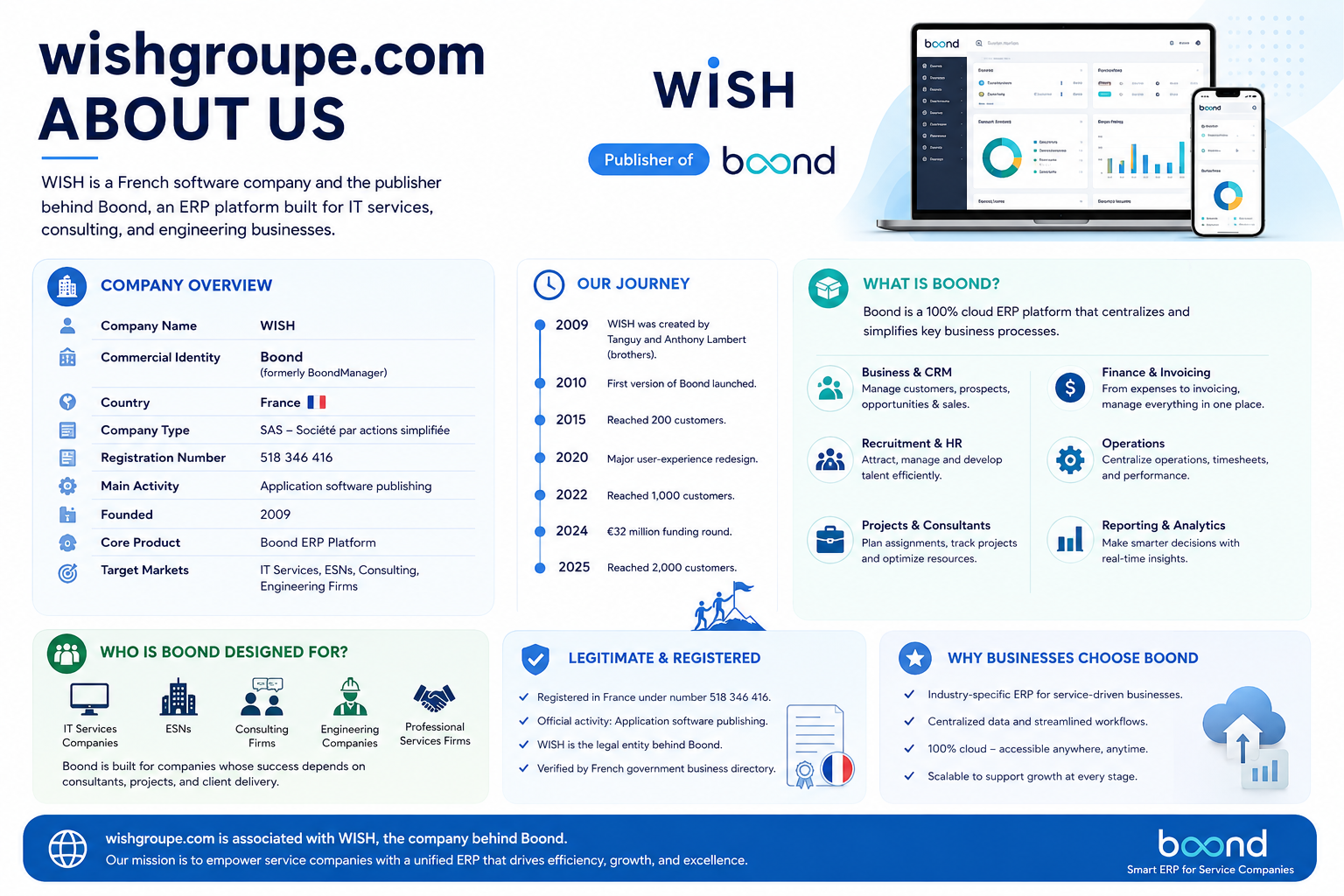
Searching for wishgroupe.com about us usually means you want more than a basic company description. You may want to know who operates the domain, what the business actually does, whether it has a legitimate corporate identity, and how its services connect with the Boond software platform.
Public business records and Boond’s current official website provide a useful picture. WISH is a registered French company associated with the development and publishing of Boond, an ERP platform built primarily for IT services companies, engineering firms, and consulting businesses.
This guide brings those details together so visitors can understand the organization without relying on assumptions created by the domain name alone.
wishgroupe.com Quick Facts
| Detail | Information |
|---|---|
| Company name | WISH |
| Commercial/product identity | Boond / formerly BoondManager |
| Country | France |
| Company type | SAS — Société par actions simplifiée |
| Registration number | 518 346 416 |
| Main activity | Application software publishing |
| Original creation | 2009 |
| Primary product focus | ERP software for IT services and consulting firms |
| Current product website | Boond |
| Core markets | ESNs, consulting firms, engineering businesses |
French government business records identify WISH as an active company registered under number 518 346 416 and classify its primary activity as application software publishing.
Boond’s official company history also states that WISH was created in 2009 as the publisher behind Boond.
What Is wishgroupe.com?
The name wishgroupe.com is connected with WISH, the French software company behind the business-management platform now branded as Boond.
Instead of treating the domain as an isolated website, it is more useful to understand the corporate and product relationship surrounding it. Current official Boond material identifies WISH as the original publishing company behind the software business.
The company’s journey began in 2009. The first version of Boond launched in 2010, according to the official company timeline.
Over time, the product evolved into a specialized ERP platform designed around the operational requirements of digital service companies, consulting organizations, and engineering businesses.
Who Is Behind wishgroupe.com?
WISH SAS
The corporate entity behind the business is WISH, structured as a French SAS company.
France’s official business directory records the company under registration number 518 346 416 and lists software publishing among its activities.
Public company records also connect the commercial name BoondManager with WISH.
This relationship is important because someone researching wishgroupe.com about us may encounter several names:
- WISH
- wishgroupe.com
- BoondManager
- Boond
These names are not necessarily separate businesses. They reflect the corporate entity and the evolution of its commercial software branding.
From WISH to Boond
Boond’s official history states that brothers Tanguy and Anthony Lambert founded the business in 2009. A third brother later joined the company as it continued developing its specialized software platform.
According to the company’s timeline:
- WISH was created in 2009.
- The first Boond version launched in 2010.
- The company reached 200 customers by 2015.
- A major user-experience redesign followed in 2020.
- The customer base reached 1,000 in 2022.
- A €32 million funding round was announced for 2024.
- The company reported reaching 2,000 customers in 2025.
These milestones show a business that has developed from a software project into a broader SaaS operation focused on a specific professional market.
What Does the Company Actually Do?
WISH’s best-known product is Boond, a cloud-based ERP platform.
Unlike a basic CRM that concentrates mainly on customer relationships and sales pipelines, an ERP attempts to centralize multiple areas of company management.
Boond describes its platform as an integrated system covering areas such as business development, recruitment, HR, finance, projects, operational management, and reporting.
Business and CRM Management
Commercial teams can use ERP functionality to organize prospects, customers, opportunities, and other sales-related activities.
The goal is to reduce the need for disconnected tools and provide business teams with a more consistent view of ongoing commercial activity.
Recruitment and Human Resources
Recruitment is particularly important for IT service and consulting businesses because employees and consultants often need to be matched with client assignments.
Boond provides functionality aimed at recruitment and HR workflows alongside its wider business-management features.
Project and Consultant Management
Professional-service businesses need to understand where employees are assigned, how projects are progressing, and how resources are being used.
Boond’s product positioning specifically targets these operational requirements for consulting and IT service organizations.
Finance and Invoicing
The platform also includes financial management functions.
According to Boond’s published product information, its ERP is designed to connect commercial activity, projects, timesheets, expenses, invoicing, HR, and related company data within the same environment.
This integrated approach can be particularly useful for companies where consultant activity directly affects billing and profitability.
Who Is Boond Designed For?
Boond does not position itself as a completely generic business application.
Its official materials focus specifically on organizations such as:
- IT services companies
- ESNs
- consulting firms
- engineering companies
- professional-services businesses
- firms managing consultants and client assignments
That specialization is one of the most important details to understand when researching wishgroupe.com about us.
A small retail store or ordinary ecommerce company may have very different ERP requirements. Boond’s positioning is centered on organizations whose operations depend heavily on consultants, employees, client projects, recruitment, commercial opportunities, and service delivery.
What Makes the Business Model Different?
Industry-Specific Software
Many ERP platforms attempt to support almost every industry.
Boond follows a narrower strategy.
Its official company profile says the platform was created specifically around real workflows found within ESNs and consulting firms.
That can potentially reduce the amount of customization required compared with implementing a completely generic management platform.
Centralized Operations
A major problem in growing businesses is tool fragmentation.
Sales may work in one platform. Recruiters use another. Finance depends on spreadsheets. Project managers maintain separate systems.
A specialized ERP aims to bring those workflows closer together so teams are working from shared operational information.
Cloud-Based Access
Boond identifies its ERP as a 100% cloud platform accessible through connected devices rather than an exclusively on-premise system.
For distributed consulting companies this can be particularly relevant because employees, consultants, managers, and administrative teams may work from different locations.
Is wishgroupe.com Legitimate?
A domain alone should never be the only factor used to judge a company.
For wishgroupe.com, however, there are several independent signals connecting the name WISH with an identifiable French software business.
The French government’s business directory identifies WISH as a registered company with registration number 518 346 416.
Boond’s own official history identifies WISH as the company created in 2009 to publish Boond.
Apple’s App Store also lists Wish as the provider of the Boond application and describes the application as a version of the BoondManager ERP platform.
Taken together, these sources provide substantially stronger verification than a domain name or an unverified third-party review alone.
A Note About the wishgroupe.com Website
During an August 2026 web check, the root wishgroupe.com address could not be successfully retrieved and returned a server error through the web fetch used for this research. Website availability can change, so this should not be interpreted by itself as evidence about the company’s operating status.
The important distinction is that website availability and company existence are separate questions.
Even when an older company domain is unavailable, official business registration and the organization’s active product website can provide better evidence about the underlying company.
For current information about the product, Boond’s active official website provides considerably more detail about the company, its history, platform, team, and services.
How to Verify a Company Before Sharing Information
Even where a company has legitimate public records, basic verification is still sensible before sharing financial, personal, or business-sensitive information.
1. Confirm the Exact Website
Look carefully at the domain in your browser.
Small spelling differences can lead to unrelated websites or impersonation attempts.
2. Match the Legal Company Name
If an invoice, contract, subscription, or payment request uses the WISH name, compare the legal details with reliable business records.
Key information should remain internally consistent.
3. Check the Product Relationship
If someone approaches you regarding Boond or BoondManager, check whether the communication logically matches the company’s current product identity and official channels.
Do not rely solely on a logo in an email.
4. Verify Unexpected Payment Requests
A legitimate company can still be impersonated.
If bank information suddenly changes or you receive an unusual request for payment, independently verify it through an established contact channel before transferring funds.
5. Review Contracts and Privacy Terms
For business software, understand what information will be stored and processed.
Pay particular attention to:
- account permissions
- company data
- employee information
- customer records
- payment terms
- data-processing rules
- cancellation conditions
- administrator access
- security responsibilities
These checks are useful for virtually any SaaS platform.
wishgroupe.com vs Boond: Understanding the Naming
One of the biggest sources of confusion is the difference between the company name and product name.
| Name | Role |
| WISH | Registered corporate entity |
| wishgroupe.com | Domain historically associated with the WISH name |
| BoondManager | Earlier commercial/product branding |
| Boond | Current product branding |
Official Boond materials directly describe WISH as the publisher created at the start of the company’s journey.
This is similar to many technology companies where the corporate legal name is not necessarily the name customers see on the product interface.
Why Businesses Use Specialized ERP Software
A specialized ERP becomes valuable when operational complexity begins growing faster than a company’s ability to manage it manually.
Consider a consulting company with 100 professionals.
The business may simultaneously need to track:
- active sales opportunities
- candidates
- available consultants
- ongoing client assignments
- employee leave
- timesheets
- expenses
- project profitability
- client invoices
- outstanding payments
Managing every process through isolated spreadsheets creates additional administrative work.
A centralized ERP aims to connect these activities so that information entered by one department can support another department’s work.
For example, consultant timesheets may contribute to project monitoring and eventually support invoicing. Recruitment data may help resource planning. Sales opportunities may influence hiring decisions.
This interconnected workflow is a major reason industry-specific platforms exist.
What Potential Customers Should Evaluate
A company’s history is useful, but businesses selecting an ERP should focus just as heavily on practical suitability.
Workflow Fit
List your actual daily processes before selecting software.
Do not choose an ERP simply because it has a long feature list.
Ask whether it supports how your organization really manages:
- recruitment
- sales
- staffing
- projects
- consultants
- expenses
- time tracking
- billing
- reporting
Implementation Requirements
Even intuitive software requires adoption.
Identify who will configure the system, migrate existing information, train employees, and manage permissions.
Integration
Modern companies rarely operate from a single application.
Check whether your ERP can work effectively with the accounting, recruitment, productivity, communication, and reporting tools your business already depends on.
Reporting
Data becomes useful when managers can make decisions from it.
Before committing to a platform, test whether reporting answers the questions leadership actually asks.
For example:
- Which projects are profitable?
- Which consultants are available?
- Which opportunities are most likely to close?
- Where are expenses increasing?
- How long does recruitment take?
- Which clients generate the most revenue?
Scalability
Software that works for 20 employees may become difficult at 200.
Consider future organizational structures, multiple teams, international operations, permissions, automation, reporting volume, and integration needs rather than focusing only on today’s requirements.
Common Mistakes When Researching wishgroupe.com
Assuming the Domain Name Explains the Company
It does not.
The public corporate and product relationship is more informative than interpreting the words “Wish Groupe” literally.
Confusing WISH With Unrelated Wish Companies
There are many businesses globally using “Wish” in their names.
The French WISH discussed here is specifically connected with Boond and company registration number 518 346 416.
Using Only Third-Party Review Sites
Reviews can add context, but they should not replace primary verification.
Company registries, official product websites, legal notices, and verified application listings provide stronger evidence for basic identity checks.
Treating an Old or Unavailable Website as the Entire Business
Companies frequently change domains, brands, and product identities.
Current official sources are usually more useful than relying exclusively on a legacy domain.
Frequently Asked Questions
What is wishgroupe.com?
wishgroupe.com is associated with the WISH name. Public records identify WISH as a French software company, while Boond’s official history identifies WISH as the original publisher behind Boond.
What is WISH?
WISH is a French SAS company registered under number 518 346 416. Its listed activities include application software publishing.
What is BoondManager?
BoondManager is the earlier name associated with the ERP platform now presented as Boond. The software is designed for IT services, consulting, and engineering businesses.
Is WISH connected to Boond?
Yes. Boond’s official company history states that WISH was created in 2009 as the publisher of Boond.
What does Boond software do?
Boond is an ERP platform covering business management, recruitment and HR, finance, operations, projects, and other workflows used by consulting and IT services organizations.
Is wishgroupe.com currently accessible?
An August 2026 fetch of the root domain returned a server error. Website conditions can change, and the result does not determine the legal status of the underlying company.
Is WISH a registered company?
Yes. France’s official business directory lists WISH under registration number 518 346 416.
Conclusion
Understanding wishgroupe.com about us becomes much easier once the company name, domain, and product branding are separated.
Public records identify WISH as a French software company, while Boond’s official history connects WISH directly with the creation and publishing of its specialized ERP platform. The business has evolved from its 2009 origins into a software operation focused primarily on IT services companies, consulting firms, and similar professional organizations.
For anyone evaluating the company, the best approach is to combine official corporate records with current Boond information rather than relying on the wishgroupe.com domain alone. That provides a clearer view of who operates the business, what its software is designed to accomplish, and how the WISH and Boond identities fit together.
